

CRM: Off-the-Shelf or Custom-Built in 2026
Custom CRM against Bitrix24, KeyCRM and Salesforce: real three-year cost, when your own build pays back, how to migrate data and what a CRM costs at DEXA.


Every time a business owner says “a CRM does not work for us”, they mean something else: “we pay for features we never open, and we still cannot do the one thing we need”. That is exactly where the choice between an off-the-shelf product and a CRM built around your process begins.
This is not a rewrite of vendor brochures but an engineering look: what the real three-year cost is made of, where a ready-made platform quietly eats money, and under which conditions building your own pays back. We have been shipping CRMs for over seven years, so we also show honestly when you do not need one.
In short
Pick an off-the-shelf CRM when the process is standard and the sales team is under 10 people.
A custom CRM pays back when the process itself is your competitive edge, when there are 15+ managers, or when you need integrations the platform cannot give you.
Three cost lines everyone forgets: data migration, licences you buy “for growth”, and the hours spent working around limits.
DEXA benchmark: a custom CRM from $3,614 (₴150,000), first working version in 8–12 weeks.
Why “the CRM does not fit”: three typical scenarios
Name the reason it hurts before choosing a tool. In 90% of the projects that come to us, it is one of these three.
Scenario 1. The process is wider than a funnel. A manager logs the enquiry, a technician visits the site, a quote is prepared, then approval, prepayment, installation, sign-off. In a boxed CRM two of those stages exist; the rest live in a spreadsheet and a chat thread.
Scenario 2. An integration that does not exist. The system has no idea this customer is already in your accounting software, or that the warehouse has already reserved the line items from the quote. In a ready-made platform each such bridge is either expensive, impossible, or both.
Scenario 3. Reporting assembled by hand. A manager wants margin per salesperson, not “number of deals”. That is a calculation across four data sources, and in a boxed CRM it ends with an export to a spreadsheet.
An honesty test: if you cannot name a specific process the system fails to cover, you probably do not need custom development. You need a proper implementation and a trained team.
What you actually buy with an off-the-shelf CRM
The subscription is only the first line of the budget. This is the full cost structure we see in audits.
| Cost line | Off-the-shelf (subscription) | Custom CRM |
|---|---|---|
| Start | $0–150 setup | from $3,614 (₴150,000) |
| Licences over 3 years | $15–50/user/month × users × 36 | hosting $40–100/month |
| A non-standard integration | from $241 (₴10,000) each, sometimes impossible | included in the build |
| Adapting it to your process | depends on the vendor roadmap | anything, within your team |
| Vendor price increases | high risk | under your control |
| Data and export | API limits, export caps | full access |
| Speed | depends on the vendor’s load | tuned to your scenarios |
The second row is the important one. For a 25-person team at $25 per seat, licences alone are $7,500 a year — $22,500 over three years — and that figure grows with every new hire, even the one who logs in once a week. Add the vendor-side customisation a real process usually needs ($5,000–20,000 across three years) and the comparison stops being about “cheap versus expensive”.
When the ready-made option is the right call
We start here deliberately, because honesty sells worse than the truth. Choose a SaaS CRM if:
- you have under 10 managers and a standard “lead → deal → invoice” process;
- you need to be live this week, not next quarter;
- the integrations you need (mail, telephony, messengers, ERP, Shopify) already exist in the platform;
- nobody on your team can act as the internal product owner of the system;
- the subscription is smaller than the salary of two managers, so the risk is financially invisible.
In those cases our advice to clients is blunt: take Bitrix24, KeyCRM or a funnel in Notion, invest in configuration and written rules, and come back to custom development in two or three years when you have outgrown it.
A ready-made CRM can still be shaped to you: deal templates, automatic stages, reports. If the pain is still there after two weeks of serious implementation, the problem is the platform’s limits, not your team.
What a custom CRM is made of
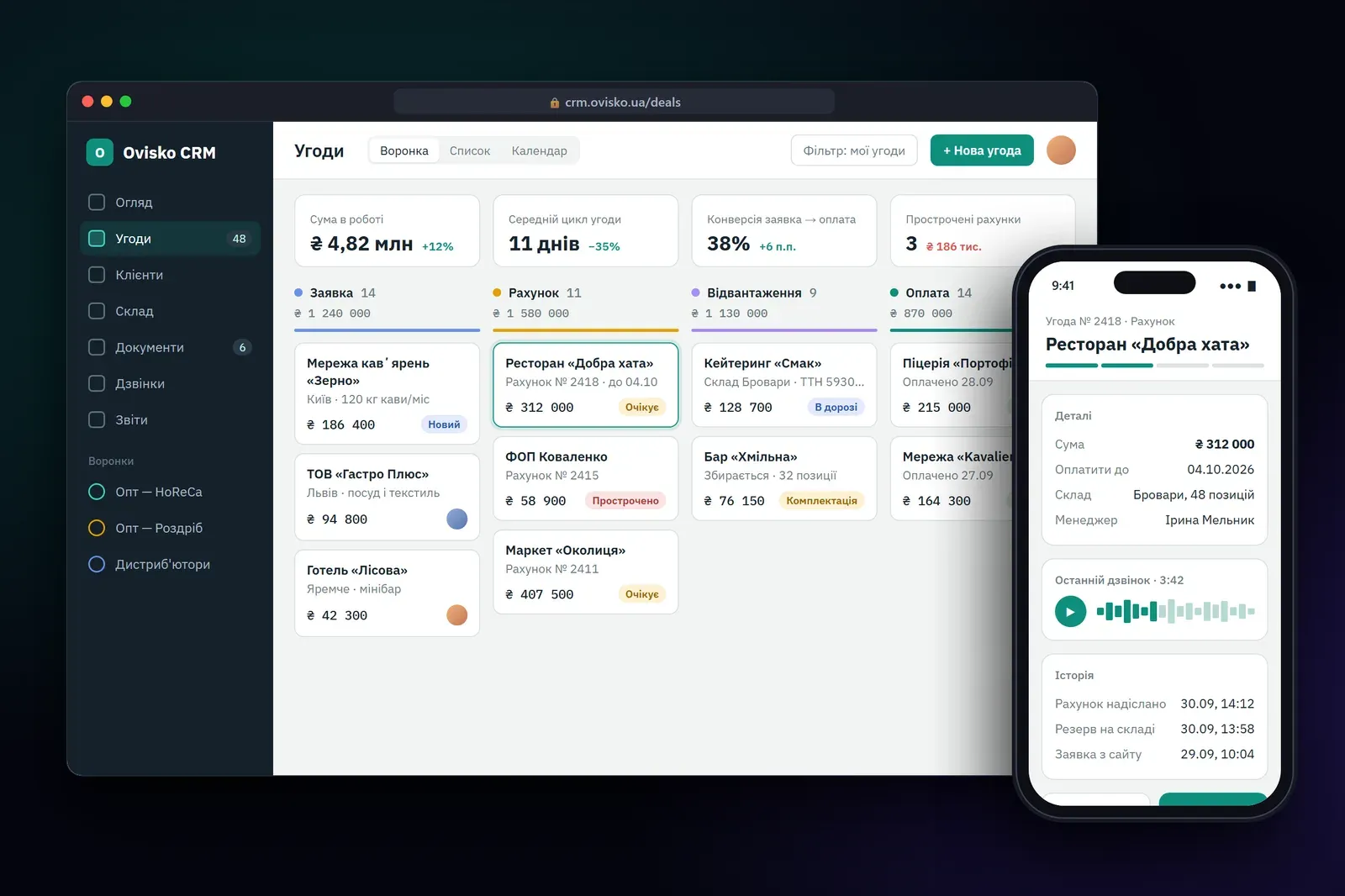
A custom CRM is not “a big website” — it is four layers. We agree them before the start, so the client knows what they are paying for.
1. Data and reference models
A structure that mirrors your real entities: not “company / contact / deal” but “site, tender, quote, act, warranty period” if you are in installation. Mistakes here are the most expensive, because changing the schema half a year later means migrating twice.
2. Business logic and pipelines
Stages, transition rules, margin calculation, discount limits, approvals. This is precisely why custom development exists: your process becomes code instead of a compromise with somebody else’s interface.
3. Integrations
Telephony, mail, messengers, ERP and accounting, delivery services, payment systems, warehouse, production logistics. In our practice these links are the expensive part — the CRM and the accounting system that stop needing anyone to copy line items by hand.
4. Roles and reporting
What a manager sees, what a director sees, what accounting sees. And dashboards in real money, not in “activity counts”.
Budget and timeline: an open calculation
Estimates for a typical DEXA project: a service or manufacturing business, 15–30 managers, non-trivial approval logic.
| Stage | Timeline | Budget |
|---|---|---|
| Process analysis, spec, prototype | 2–3 weeks | $600–900 |
| MVP: reference data, pipeline, roles, one integration | 8–10 weeks | from $3,614 (₴150,000) |
| Production version: all integrations, reporting | +6–8 weeks | +$2,200–3,600 |
| Support, hosting, development | ongoing | $200–500/month |
First year in total: roughly $7,500–9,500. Years two and three are support and growth only, $2,500–6,000 a year. So for a team of 20 the crossover — where your own system becomes cheaper than a subscription plus workarounds — usually lands between month 14 and month 20 of use.
Three conclusions worth remembering
Price the ready-made CRM over three years including integrations and customisation, then compare it with one development budget.
Do not pay for “everything at once”: an MVP in 8–12 weeks, then growth driven by how people actually use it.
The real saving is not licences — it is the team hours that stop being spent working around the system.
Migration: how not to lose the customer history
The part clients fear most is moving the data. We do it in four steps and never say “just export everything to CSV”:
- Audit the current base. Duplicates, dead contacts, fields nobody ever filled. Migrating junk makes the project heavier without making it useful.
- Field mapping. Matched against the new schema, with explicit rules for empty values and conflicts.
- A full dry run on a copy. Everything imported into a staging environment, totals and counts reconciled, a signed-off result.
- A parallel period. Two to four weeks with both systems live, the team trained and the numbers compared. Only then does the old CRM go read-only.
Never accept a migration without a parallel period. It is the step that saves you from discovering a week later that the interaction history of the clients who produced 40% of revenue is gone.
Summary: what to do in your case
Commission a custom CRM when the process is what sets you apart — installation, service, production, tenders, complex prepayments. The process is what makes you money, and a system that reproduces it exactly pays back faster than any subscription.
If you are only now leaving spreadsheets and chat threads, start with a ready-made tool. We will help with configuration and data hygiene so that in a year you can move to your own build deliberately rather than desperately.
DEXA builds a CRM for from $3,614 (₴150,000) with a first working version in 8–12 weeks: process analysis, a role model, pipelines, ERP and telephony integrations, margin reporting and post-launch support. Details on the CRM development service, examples in the portfolio, packages on the pricing page. Related: business process automation and AI in automation.
Want the calculation for your situation? Tell us which systems you use today and how many people are in sales. Within 24 hours you get a “ready-made versus custom” comparison over three years for your case specifically.

automation from $2,410 (₴100,000) · a custom CRM from $3,614 (₴150,000) · CRM with AI from $6,024 (₴250,000)
Need the same solution for your business?
Three rungs: process automation on ready services, a custom CRM built around your scenario (pipelines, tasks, documents) and a CRM with an AI module. Telephony, mail and warehouse integrations.
- An audit and a process map: where deals and hours leak
- A custom CRM on React/Vue: pipelines, tasks, documents
- Integrations: telephony, mail, warehouse, your API and dashboards
Get a free website audit in 48 hours
Speed, SEO, conversion — a 12-page report with a prioritized fix plan. No obligation, no spam: we show what to improve even if you never hire us.

