

Web App & SaaS Development
Complex products on Angular, React and Vue: dashboards, internal systems, APIs and cloud infrastructure.
- Lite $4,819 ₴200,000
- Standard $8,434 ₴350,000
- Premium $14,458 ₴600,000
- Price and timeline fixed in the contract
- The code and domain are yours
- Reply within 2 hours, Mon–Sat 9:00–20:00
Customers call to ask for status while the data lives in spreadsheets?
Tick what sounds like you
Matches 0 of 6
A portal where customers see it all
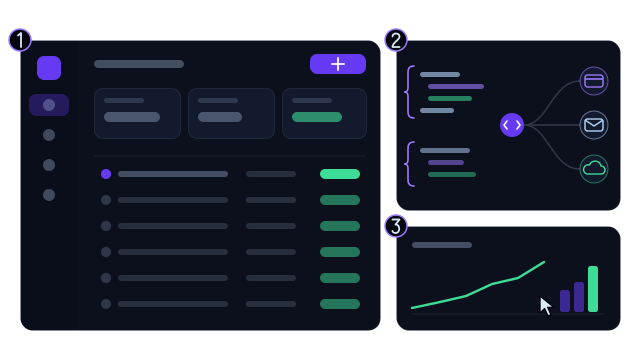
A customer logs in and sees the status, documents and history. The data comes from your accounting through an API, with no calls to a manager.
-
What your customer sees
- Sees status and documents in their account
- Gets notified when the status changes
- Works from a phone just as from a laptop
-
What runs inside
- Web app with customer accounts from $4,819 (₴200,000)
- Integration with 1C, BAS or a CRM from $964 (₴40,000)
- Support after release from $193 (₴8,000)/mo
The bundle has no price of its own: each part can be ordered separately, at the price of its tier.
-
What you get
- Fewer «where is my order» calls
- Roles and access for the team and partners
- An API for partners and new services
Customers called instead of checking the status, and the tool ate managers’ hours.
A map, roles and a public API in one dashboard.
Calls asking «where is my order» drop by 50–70%, because customers see the status themselves.
A guide, not a promise: the actual figure depends on your niche, traffic and how fast your team replies.
Who needs a web app
Recognise even one of these and the rest of this page answers that exact case.

-
The prototype is validated, now it must become a product
Early users showed what works and what does not. What is needed now is an architecture that survives a year, not a demo week.
-
The internal system outgrew its spreadsheets
Warehouse, logistics, production: when Excel stops holding it, you need roles, permissions and an audit trail.
-
You need a SaaS with subscriptions
User areas, plans, limits, billing and self-service — the line where a product becomes a business rather than a website.
-
Load grows and the architecture hurts
Releases are painful, downtime is expensive and every new feature touches three older ones — that is an architecture symptom, not a developer one.
What a web-app build includes
This list sits in the estimate and the contract; anything else is agreed separately.
Web App & SaaS Development
- Price
- from $4,819 (₴200,000)
- Timeline
- 10–14 weeks
We engineer products that live for years: modular architecture, type-safe code, role-based auth and real-time data. We deploy to the cloud with CI/CD and monitoring so releases are frequent and downtime is rare.
- Architecture & API
- Auth and roles
- Cloud deploy with CI/CD & monitoring

Included in the scope
- Architecture and technical choices, justified
- A data model and a type-safe API
- Authentication, roles and permissions
- A user area and an admin console
- Subscriptions, limits and billing
- Real-time data handling
- Tests and a mandatory code review
- CI/CD deployed to your own cloud account
- Monitoring, alerts and logs
- Backups and a recovery plan
- Documentation and a handover to your team
- Weekly progress demos
What changes after launch
The product grows without fear
Modules, tests and typing from day one: a new feature does not break what already works for your customers.
New features every week
CI/CD ships updates without downtime, so customer feedback becomes a feature in a week rather than a quarter.
Holds up as you grow
Cloud infrastructure scales with the number of users, and the product stays fast as customers multiply.
What a web app costs
“From” is the floor, not the quoted amount. The real budget appears after the brief and is fixed in the contract.
from $4,819 (₴200,000)
One module you can put in front of users in 10–14 weeks.
What is included
- One role, one core module
- One-off payment instead of a subscription
- A cloud deploy
- Basic testing
- We write the copy from your facts
- 2 design rounds
What is not
- Subscriptions and several modules are in Standard
- A public API and scaling are in Premium
30-day warranty · Payment 30/40/30
After launch: 1 month of Lite care
from $8,434 (₴350,000)
Several modules, roles and subscriptions — the product is already selling to someone.
What is included
- Up to three roles, several modules
- Subscriptions, invoices, an internal API
- Monitoring and automated tests
- Two or three kinds of dashboard
- We write the copy from your facts
- 3 design rounds
What is not
- A documented public API is in Premium
- Multi-tenancy and payouts are in Premium
30-day warranty · Payment 30/40/30
After launch: 3 months of Standard care
from $14,458 (₴600,000)
A platform with third-party developers on the API, real load and payouts.
What is included
- Unlimited roles, the full platform
- A public API with documentation
- Multi-currency and payouts
- Scaling, redundancy, load testing, an SLA
- We write the copy from your facts
- 4 design rounds
What is not
- Marketing and selling the product is your side
- 24/7 user support is a separate agreement
30-day warranty · Payment 30/40/30
After launch: 6 months of Premium care
What moves the price
- How many modules and roles the system has
- Real time, offline mode and synchronisation
- How many external APIs, and how well-behaved they are
- Security and data-retention requirements
- Whether a mobile app rides the same API
- Release cadence: infrastructure and CI/CD
Paid separately
- Cloud capacity — on your account, at your tariff
- Paid services: maps, SMS, telephony, email APIs
- A security audit or a pentest when a regulator asks for one
- Store publishing for a mobile wrapper
- Further development and on-call after the first release
- Onboarding content and copy
A web app or a ready service
The same request can be built three ways — the difference is what the product looks like a year later.
| Criterion | A builder | One outsourced developer | An engineering team |
|---|---|---|---|
| What ships | A builder A bounded set of ready blocks | One outsourced developer Code one person understands | An engineering team Modules, tests and documentation |
| A year of growth | A builder Hits the platform’s limits | One outsourced developer Depends on the author staying | An engineering team A new developer is productive within a week |
| Load and downtime | A builder The platform’s problem | One outsourced developer Rarely in the brief | An engineering team Autoscaling, monitoring, a recovery plan |
| Security and permissions | A builder Whatever the platform defaults to | One outsourced developer Depending on luck | An engineering team Roles, an audit trail, isolated environments |
| When this is the right choice | A builder Testing demand in a week | One outsourced developer A small module with clear edges | An engineering team The system the business earns on |
What we write into the contract
This list sits in the estimate and the contract — the manager repeats it on the call too.
A project starts at $506 (₴21,000)
Discuss the terms- A fixed estimate after the free brief
- Payment in stages 30/40/30, 50/50 on Lite
- Dated stages and a delivery date
- The warranty is 30 days, 60 on the corporate Standard and 90 on the Premium — defects free of charge, changes outside the tier billed separately
- Domain, hosting, code and access registered in your name
- Revisions built into each stage: the layout is approved before it is coded
- Agreement, invoice and act — the pack your accountant asks for
How we work
Six steps from idea to launch — sequential, transparent and predictable.
Brief & analytics
We study your business, competitors and audience. Define goals and success metrics.
- Goals & metrics
- project map
- scope
- estimate
Prototype & design
We design the structure, create the UI concept and approve the visual language.
- UX prototype
- UI concept
- design system
- responsive
Development
Layout, code, content. Weekly progress demos keep you in the loop.
- Frontend
- business logic
- integrations
- headless CMS
Testing & QA
We check on real devices and browsers, fix edge cases and log the speed figures in a report.
- Cross-browser QA
- Core Web Vitals
- automated tests
- a11y
Launch
We deploy to production and connect the domain, SSL, analytics and monitoring.
- Deploy
- domain & SSL
- analytics
- 301 redirects
- SEO base
Growth & support
We keep growing the product: new features, A/B tests, speed improvements and a support plan with defined response times.
- Iterations
- A/B tests
- speed & conversion
- monitoring
- support
DEXA projects


What people say after launch
Quotes taken from working threads — rough edges included.
Solutions for a specific job
Ready-made scenarios for your case — with examples and indicative pricing.
- E-commerce · marketplaces Marketplace development, turnkey See the solution
- CRM · wholesale & B2B A CRM for wholesale: the deal run from enquiry to payment See the solution
- Websites · hospitality A website for a hotel that takes bookings around the clock See the solution
- E-commerce · beauty A cosmetics store that carries the buyer to checkout See the solution
- CRM · logistics A CRM for logistics: cargo tracking that ends the “where is my shipment” calls See the solution


- Websites · finance A website for fintech and investment firms: trust and stability See the solution
- Site-card · legal services A lawyer’s site-card that shows the specialisation See the solution
- Landing · auto service A car service website that fills the schedule See the solution
- Websites · healthcare and dental A clinic website: booking a doctor without a call See the solution
- Websites · beauty salons A beauty salon website where clients book themselves See the solution


- Websites · restaurants and cafés Restaurant website: menu, table booking and banquets See the solution
- Websites · online schools and courses Online school website: courses, syllabus and cohort sign-up See the solution
- Websites · psychologists and therapists A psychologist website: clients book without hesitating See the solution
- Websites · real estate agencies Website and CRM for a real estate agency See the solution
- Websites · construction and renovation Construction company website: projects, calculator and quotes See the solution


- Websites · travel agencies Travel agency website: tour search, last-minute deals and matching See the solution
- Websites · cleaning Cleaning company website: price, time and payment without a call See the solution
- Websites · barbershops Barbershop website: book your barber without calls or DMs See the solution
- Websites · kindergartens Private kindergarten website: parents see prices and book a tour See the solution
- Websites · driving schools Driving school website: the course price before a call and online group sign-up See the solution


Questions about web apps
What people ask about this product specifically — price, timeline and where responsibility sits.
Hi! I’m from the DEXA team. Pick a question — I’ll answer right away, no “a manager will call you back”.
What does a web application cost?
The entry is from $4,819 (₴200,000) for a modular MVP with auth, a user area and billing.
A harder system with real-time data and several integrations is priced after an architecture session, and it can be double.
How many weeks to an MVP?
10–14 weeks is the core loop with a first release. After that the pace is set by stages: we agree a list of iterations, not “everything at once”.
Can we start small and grow?
Yes, and it is the right route.
One condition: the architecture and the data model are agreed before the first line of code, so the MVP is not rewritten after six months.
Who maintains it after release?
You, with our documentation and training, or us as separate work.
We do not build a system that stops without us — on the contrary, we hand over access and write down the deployment.
Are you accountable for downtime?
For our side, yes: monitoring, alerts, backups and a recovery plan are in the work.
We do not become “a server with a 99.99% guarantee” — that is the cloud provider’s and your account’s territory.
Will you build a mobile app?
Usually the right call is a web app that works on a phone, or a PWA: one codebase, one API, one update channel.
Native is justified by offline logic, the camera, push or store requirements.
The previous team abandoned the project. Will you finish it?
Yes. First we go through the code and whatever documentation exists, then tell you what can be kept and what is cheaper to rewrite.
The estimate is fixed after that review, not before it. We have already taken a product another team abandoned halfway through to release.