

Marketplace development, turnkey
We design a multi-vendor platform around your process: from a thousands-of-SKU catalogue to splitting payments across dozens of sellers. Not a template or a builder — a product that survives growth.

- Indicatively
- from $3,614 (₴150,000)
- Timeline
- 8–14 weeks
- Warranty
- 30 days
A marketplace is not “a store with extra pages” but a distinct architecture: roles, payouts, moderation, commissions and load. We start from the data model and business process, not the design, so the platform scales without a rewrite.
- Fixed estimate after a brief
- Speed measured before handover
- Reply within 2 hours on working days
- Seller dashboard Sellers add products and see sales themselves — no manager in the middle.
- One cart A buyer pays for items from different sellers in one payment.
- Payouts and commission The platform commission and seller payouts are calculated automatically.
A marketplace: from scratch or rebuild the one you have
Pick your situation — below you can see what we do in each.
No platform yet
A platform exists, but cannot cope
Where a marketplace loses sellers and buyers — and what the platform does about it
Five steps from a seller to a payout. At each one money or people get lost.
-
A seller joins
Signs up and adds products.
Leaves if:a manager adds products by hand.
The site does:a seller dashboard with product upload.
-
A buyer searches
Finds a product in a large catalogue.
Leaves if:search and filters do not work.
The site does:search and filters for thousands of products.
-
Pays
Items from different sellers in one cart.
Leaves if:a separate payment to each seller.
The site does:one cart and one payment.
-
Money is split
The platform commission and the seller's share.
Leaves if:payouts reconciled in spreadsheets by hand.
The site does:split payments and automatic payouts.
-
The seller sees results
Sales, payouts, stock.
Leaves if:reporting in emails and spreadsheets.
The site does:seller reports in the dashboard.
What manual payout reconciliation costs you
Put in your numbers: how many hours a week go into reconciling payouts and the cost of a manager's hour.
You lose per month
258 $
Per year 3,096 $
This is arithmetic on your numbers, not our forecast. Move the sliders to match your schedule.
A marketplace: what it looks like
A farm-produce marketplace from our case study. The numbers mark what holds the platform together.

- Many sellers — one cart The buyer orders from different farmers and pays once.
- Cart by seller The cart shows what comes from whom.
- A card with the seller Every product shows the farm and the seller's rating.
- Seller dashboard The seller sees orders and rating from a phone.
- Checkout One checkout for the whole cart.
An off-the-shelf platform or your own marketplace
Who pays the commission, whose data it is and how payouts scale in each option.
| Criterion | Sell on someone else's platform | A marketplace builder | Your own development |
|---|---|---|---|
| Commission | Sell on someone else's platform You pay it | A marketplace builder Subscription + limits | Your own development Your commission from sellers |
| Logic | Sell on someone else's platform The platform's rules | A marketplace builder Within the template | Your own development Built for your model |
| Payouts | Sell on someone else's platform From the platform | A marketplace builder Partly | Your own development Split payments built for you |
| Scale | Sell on someone else's platform Not yours | A marketplace builder Capped by the plan | Your own development Grows with you |
| Data | Sell on someone else's platform The platform's | A marketplace builder The builder's | Your own development Yours |
How much a marketplace costs
A platform with several sellers, a shared cart and payouts needs a Premium online store or a web app. With a single seller an online store is enough.
Online store · Lite
A small catalogue: up to 100 products, one payment system, Nova Poshta.
from $1,446 ₴60,000
- Timeline
- 5–8 weeks
- Warranty
- 30 days
- After launch
- 3 months of Lite care
- Paid in stages
-
- 50% $723
- 50% $723
Online store · Standard
A full store: no product limit, several payments, 1C/BAS and a buyer account.
from $3,614 ₴150,000
- Timeline
- 8–14 weeks
- Warranty
- 30 days
- After launch
- 6 months of Standard care
- Paid in stages
-
- 30% $1,084
- 40% $1,446
- 30% $1,084
- Lite from $1,446 (₴60,000)
- +$2,169 (₴90,000) to the price Standard from $3,614 (₴150,000)
In this plan · Lite
- Up to 100 products, basic filters
- Cart, payment, Nova Poshta delivery
- Product admin, receipts/PRRO
- GA4 + e-commerce events
- We write the copy from your facts
- 2 design rounds
Not included: 1C and the warehouse are in Standard; A buyer account is in Standard
In this plan · Standard
- Unlimited products, advanced filters new
- Several payment systems, Uktposhta, Meest new
- 1C/BAS, warehouse and a buyer account included new
- Advanced SEO and bulk import new
- We write the copy from your facts
- 3 design rounds new
Not included: Prom/Rozetka and a public API are in Premium; A wholesale account and multi-currency are in Premium
The rung price covers the website on that plan. Some items below (online booking, payments, bots, integrations) are added separately: what each plan includes is on the pricing page.
What the work includes 6
- Platform architecture and data-model design
- Seller dashboards + a moderation & roles admin panel
- Checkout, payments, fund splitting and commissions
- Stock sync (warehouse / ERP) and logistics
- Search, filters and personalised offers
- An owner dashboard with sales & GMV analytics
Not covered by the price 6
- Payment-system fees for splitting payouts between sellers
- Licences and upkeep for 1C, the WMS or the warehouse software
- Contracts with delivery services and the payment provider — yours to sign
- Legal cover: the public offer, the seller agreement, tax on payouts
- Cloud capacity for the load, plus backups
- First fill: seller cards and product listings
What moves the price
- How many seller types and roles
- Complexity of payment splitting and commissions
- Catalogue size and search speed
- Which integrations are needed (warehouse, ERP, logistics)
Platform, payment and payouts: how they work together
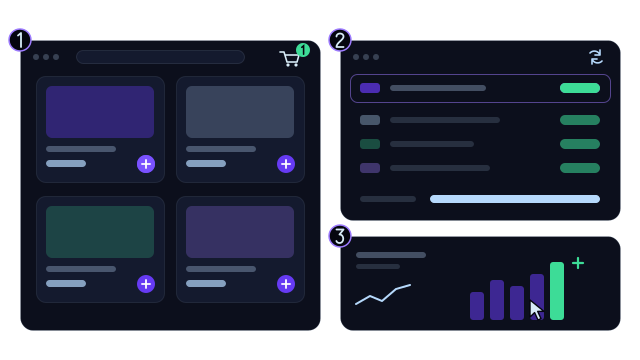
Sellers manage products in their dashboards, buyers pay in one cart, and the platform splits the money between sellers and the marketplace by itself.
-
What your customer sees
- Finds a product among sellers
- Pays in one payment
- Receives orders from several sellers
-
What runs inside
- Marketplace from $6,024 (₴250,000)
- Payment and split payments from $241 (₴10,000)
- AI chat for buyers from $24 (₴990)/mo
The bundle has no price of its own: each part can be ordered separately, at the price of its tier.
-
What you get
- The platform commission calculates itself
- Sellers work without a manager
- You see turnover and sales for every seller
Before you order a marketplace — what our clients say
Quotes taken from working threads — rough edges included.
How we build a marketplace: from brief to launch
Six steps from idea to launch — sequential, transparent and predictable.
Brief & analytics
We study your business, competitors and audience. Define goals and success metrics.
- Goals & metrics
- project map
- scope
- estimate
Prototype & design
We design the structure, create the UI concept and approve the visual language.
- UX prototype
- UI concept
- design system
- responsive
Development
Layout, code, content. Weekly progress demos keep you in the loop.
- Frontend
- business logic
- integrations
- headless CMS
Testing & QA
We check on real devices and browsers, fix edge cases and log the speed figures in a report.
- Cross-browser QA
- Core Web Vitals
- automated tests
- a11y
Launch
We deploy to production and connect the domain, SSL, analytics and monitoring.
- Deploy
- domain & SSL
- analytics
- 301 redirects
- SEO base
Growth & support
We keep growing the product: new features, A/B tests, speed improvements and a support plan with defined response times.
- Iterations
- A/B tests
- speed & conversion
- monitoring
- support
What we write into the contract
This list sits in the estimate and the contract — the manager repeats it on the call too.
A project starts at $506 (₴21,000)
Discuss the terms- A fixed estimate after the free brief
- Payment in stages 30/40/30, 50/50 on Lite
- Dated stages and a delivery date
- The warranty is 30 days, 60 on the corporate Standard and 90 on the Premium — defects free of charge, changes outside the tier billed separately
- Domain, hosting, code and access registered in your name
- Revisions built into each stage: the layout is approved before it is coded
- Agreement, invoice and act — the pack your accountant asks for
Questions about marketplace development
Prices, timelines, paperwork and ownership — the 8 questions clients ask before they order.
Hi! I’m from the DEXA team. Pick a question — I’ll answer right away, no “a manager will call you back”.
How do I attract sellers to a marketplace?
Sellers join when they see traffic, a clear commission and an easy start.
So we build an account where products are added in minutes or by import, transparent commission and payout terms, and a “Become a seller” page for search.
The first sellers are usually invited by hand; the site takes the busywork off them.
A marketplace or your own online store?
A store sells your products. A marketplace is a platform where others sell and you take a commission.
If there are several sellers who manage their products and receive payouts themselves, you need a marketplace.
We already have a platform, but reconcile payouts by hand. What do you do?
We review the platform and the data for free. We move payouts, seller dashboards and the catalogue into the system in stages, without stopping sales.
How much does marketplace development cost?
The budget depends on seller types, integration depth and catalogue size, so we lock it after a free brief.
See the entry tiers above — the “turnkey store” whose architecture a marketplace is also built on.
Will you migrate an existing store without losing traffic?
- Yes.
- First we capture the SEO baseline — donor pages, links and structured data.
- Then a page-by-page migration against the same intents, a redirect map covering 100% of URLs and a Search Console impressions check after launch.
Can you build in commissions and seller payouts?
Yes.
We wire payment splitting through Stripe Connect: each seller receives their share, the platform takes its commission, and you get transparent reporting on every transaction.
Which platform survives thousands of products?
The product is built on a fast frontend and a well-designed data model: filters and search stay responsive at large assortments, while load is handled by caching and background jobs.
Can I run the platform myself?
Yes. The moderation admin, roles and seller dashboards are built so your team manages content and operations without a developer for every step.
Useful for marketplace owners
Insights, case studies and guides from our team.

Marketplace or Your Own Store: Which Earns More
An honest calculation: marketplace and Prom commissions, traffic cost in your own store, returns, logistics and customer data, and how to combine channels.
Read article
E-commerce Platform in 2026: 6 Options Compared
WooCommerce, Shopify, site builders, marketplace stores, headless and custom development: year-one and year-three costs, real risks and a selection checklist.
Read articleNot a marketplace? Solutions for other industries
Ready-made scenarios for your case — with examples and indicative pricing.
- E-commerce · beauty A cosmetics store that carries the buyer to checkout See the solution
- CRM · wholesale & B2B A CRM for wholesale: the deal run from enquiry to payment See the solution
- Websites · hospitality A website for a hotel that takes bookings around the clock See the solution
- CRM · logistics A CRM for logistics: cargo tracking that ends the “where is my shipment” calls See the solution
- Websites · finance A website for fintech and investment firms: trust and stability See the solution


- Site-card · legal services A lawyer’s site-card that shows the specialisation See the solution
- Landing · auto service A car service website that fills the schedule See the solution
- Websites · healthcare and dental A clinic website: booking a doctor without a call See the solution
- Websites · beauty salons A beauty salon website where clients book themselves See the solution
- Websites · restaurants and cafés Restaurant website: menu, table booking and banquets See the solution


- Websites · online schools and courses Online school website: courses, syllabus and cohort sign-up See the solution
- Websites · psychologists and therapists A psychologist website: clients book without hesitating See the solution
- Websites · real estate agencies Website and CRM for a real estate agency See the solution
- Websites · construction and renovation Construction company website: projects, calculator and quotes See the solution
- Websites · travel agencies Travel agency website: tour search, last-minute deals and matching See the solution


- Websites · cleaning Cleaning company website: price, time and payment without a call See the solution
- Websites · barbershops Barbershop website: book your barber without calls or DMs See the solution
- Websites · kindergartens Private kindergarten website: parents see prices and book a tour See the solution
- Websites · driving schools Driving school website: the course price before a call and online group sign-up See the solution


Don’t know where to start? Let’s build the brief together
Answer a few questions and our builder assembles a complete, ready-to-share project brief — with a realistic budget range calculated from our real packages. Take it to us or to any studio.
~3 minutes · no email required to view your estimate
- 6 guided steps — goals, scope, design, budget
- Instant price range from real DEXA packages
- Downloadable, print-ready brief (PDF)